
Germany’s Zeitenwende 2.0: Shaping Europe’s New Security Order and the Strategic Implications for Portugal
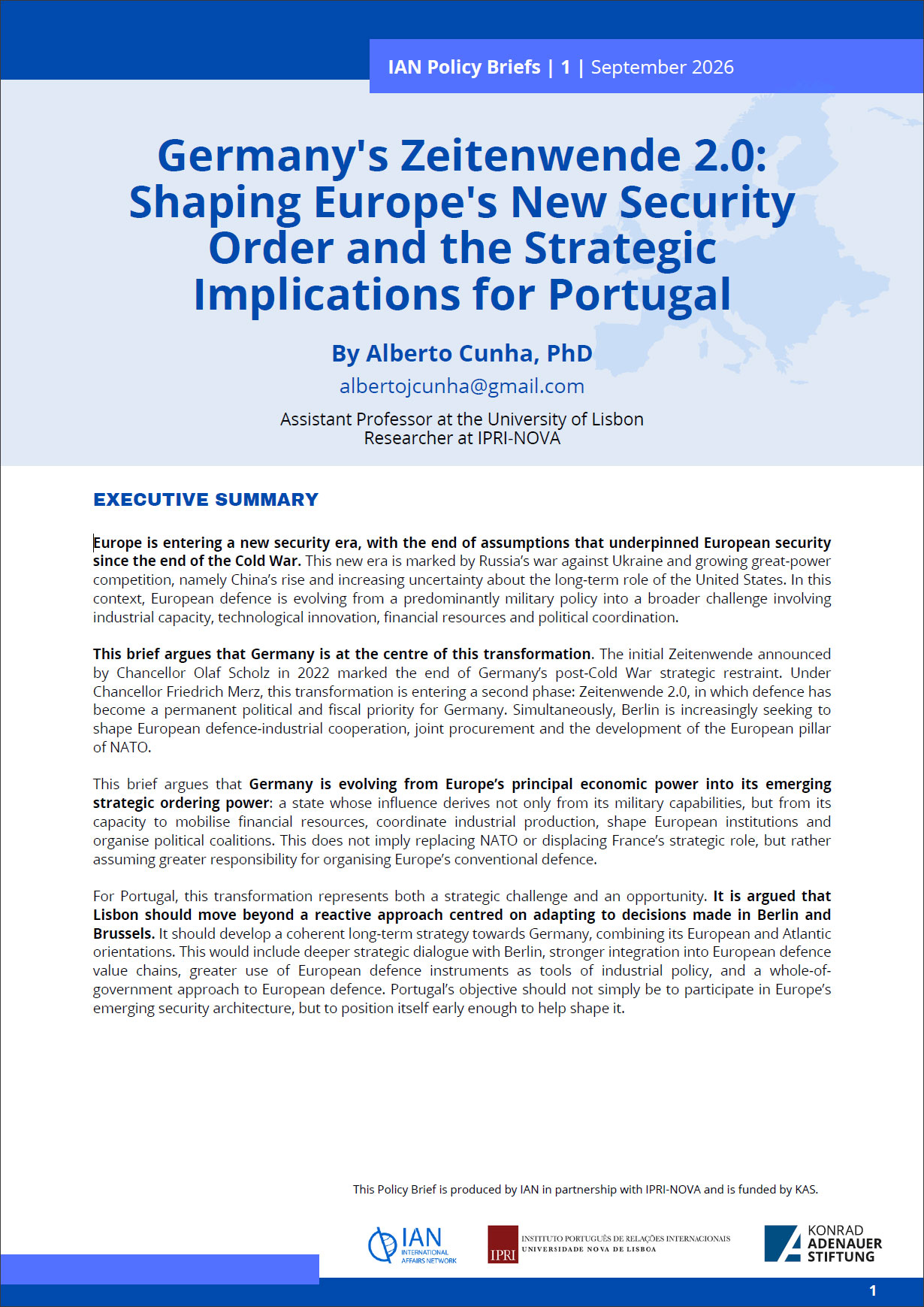
Europe is entering a new security era, with the end of assumptions that underpinned European security since the end of the Cold War. This new era is marked by Russia’s war against Ukraine and growing great-power competition, namely China’s rise and increasing uncertainty about the long-term role of the United States. In this context, European defence is evolving from a predominantly military policy into a broader challenge involving industrial capacity, technological innovation, financial resources and political coordination.
This brief argues that Germany is at the centre of this transformation. The initial Zeitenwende announced by Chancellor Olaf Scholz in 2022 marked the end of Germany’s post-Cold War strategic restraint. Under Chancellor Friedrich Merz, this transformation is entering a second phase: Zeitenwende 2.0, in which defence has become a permanent political and fiscal priority for Germany. Simultaneously, Berlin is increasingly seeking to shape European defence-industrial cooperation, joint procurement and the development of the European pillar of NATO.
This brief argues that Germany is evolving from Europe’s principal economic power into its emerging strategic ordering power: a state whose influence derives not only from its military capabilities, but from its capacity to mobilise financial resources, coordinate industrial production, shape European institutions and organise political coalitions. This does not imply replacing NATO or displacing France’s strategic role, but rather assuming greater responsibility for organising Europe’s conventional defence.
For Portugal, this transformation represents both a strategic challenge and an opportunity. It is argued that Lisbon should move beyond a reactive approach centred on adapting to decisions made in Berlin and Brussels. It should develop a coherent long-term strategy towards Germany, combining its European and Atlantic orientations. This would include deeper strategic dialogue with Berlin, stronger integration into European defence value chains, greater use of European defence instruments as tools of industrial policy, and a whole-of government approach to European defence. Portugal’s objective should not simply be to participate in Europe’s emerging security architecture, but to position itself early enough to help shape it.